
For years, enterprise customer support operated under a costly compromise. If you wanted instant responses, you deployed a chatbot a rigid matrix of “if/then” rules that routinely misunderstood users. For context, empathy and actual resolution, you routed users to a human queue. This forced businesses to tolerate high operational friction and compounding overhead.
That compromise is over.
In 2026, the customer experience (CX) landscape is undergoing what system architects call the Agentic Shift. Driven by compounding advances in AI, enterprise support architectures have migrated away from simple text-generation wrappers. Leading organizations now deploy autonomous AI Agents. These systems process multi-step reasoning, execute cross-platform API requests and coordinate complex backend tasks independent of human intervention.
Recent market analytics highlight the velocity of this transition:
- Data from Grand View Research indicates the global AI customer service market is projected to surpass $15.12 billion by late 2026
- A 2026 Gartner survey reveals that 91% of customer service leaders face intense pressure from executive leadership to deploy these advanced architectures , with concrete plans to transition routine tier-1 interactions to fully autonomous workflows.
For Chief Technology Officers, Customer Experience directors and digital product owners, this guide serves as an operational blueprint to build and scale an Enterprise AI Chatbot framework that delivers structural ROI without compromising data security.
1. The Evolution of Customer Experience: From Basic Chatbots to Agentic AI
How the Development of Artificial Intelligence Redefined the Helpdesk
To appreciate the power of 2026 systems, we must look at how the artificial intelligence development reshaped the digital helpdesk.
- Generation 1 (Rule-Based Trees): The early era relied on rigid decision trees. If a user typed “track order,” they were forced down a fixed script. If their query strayed by a single syllable, the system broke.
- Generation 2 (The LLM Wrappers): Following the initial Generative AI boom, companies rushed to build thin middleware layers on top of public foundation models. While these chatbots sounded human, they lacked business context, hallucinated policies and could not securely alter backend databases.
- Generation 3 (Agentic AI Systems): The current landscape pairs advanced AI and machine learning models with structural agentic frameworks. Modern systems predict intent, access specific business databases via real-time vector queries, validate their own output against corporate compliance protocols and securely execute multi-step scripts across external CRMs.
Structural Showdown: AI Agent Development vs. Traditional Software Development
Building an intelligent, self-correcting agent requires a complete departure from legacy engineering pipelines. Traditional software development is deterministic, relying on explicit code paths. Agentic design patterns leverage the probabilistic reasoning of neural networks to navigate unpredictable human inputs with minimal manual maintenance.
| Feature / Paradigm | Traditional Software Development | Modern AI Agent Development |
| Logic Foundation | Hardcoded logic loops, rigid regex matches and static if/then scripts. | Probabilistic reasoning powered by an underlying AI framework. |
| Data Integration | Manual API mappings requiring custom code for every endpoint. | Dynamic API orchestration; the agent reviews API specifications and executes calls autonomously. |
| Taxonomy Tuning | Heavy manual maintenance; engineers must continuously update database keyword tags. | Deep learning semantic vectors that automatically comprehend context, synonyms and intent. |
| Handling Edge Cases | Fails or throws an error code if the exact user input isn’t predefined. | Evaluates the nearest compliant corporate policy and safely self-corrects the route. |
2. The Core Framework: How to Train an AI Chatbot on Custom Business Data
Moving Beyond Basic Open AI Development Layouts
When enterprises build an intelligent support engine, they quickly realize that a standard, out-of-the-box public model layout is unviable. Relying strictly on basic cloud APIs introduces catastrophic vulnerabilities: proprietary business data can leak into public training pools and generic foundation models lack the nuanced, hyper-specific context of internal operations.
Instead of deploying fragile public wrappers, modern software architecture pairs custom foundation models with specialized visual orchestration platforms (such as Botpress or Dify) running on private cloud servers. This open AI development alternative ensures total data isolation while giving developers precise, granular control over the agent’s prompt guardrails, workflows and API permissions.
Demystifying Retrieval-Augmented Generation (RAG) and Custom LLMs
To AI chatbot development systems that genuinely perform, you must feed them your proprietary corporate knowledge including PDFs, complex policy manuals, legacy helpdesk tickets and internal software documentation. The industry-standard architecture for achieving this securely is Retrieval-Augmented Generation (RAG).
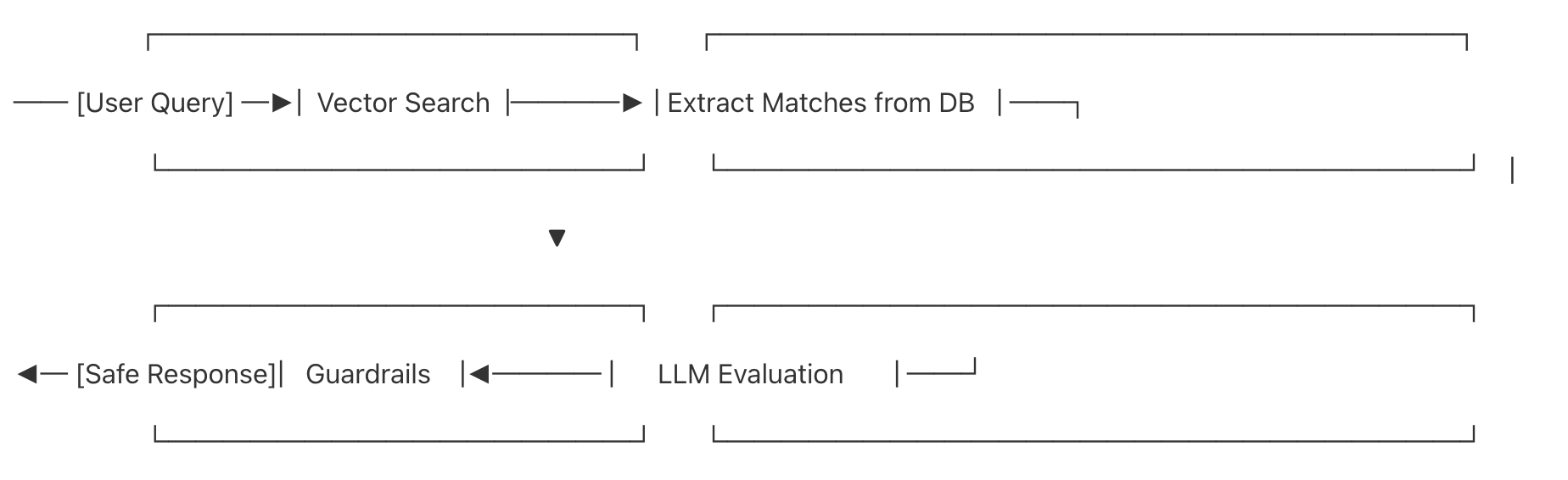
- Chunking and Ingestion: The system ingests unstructured corporate documentation and breaks it down into semantic blocks using token-aware splitting algorithms.
- Vector Transformation: These blocks are converted into mathematical coordinates called “embeddings” using an advanced artificial intelligence framework. These embeddings map concepts based on meaning rather than exact keywords.
- Storage: The coordinates are stored inside a high-speed vector database (such as Pinecone, Milvus or Qdrant).
- Retrieval: When a customer asks a question, the vector database instantly pulls the exact paragraphs containing the correct policy. It then hands those verified text snippets directly to the LLM core as an absolute source of truth.
By keeping the model rigidly anchored to approved corporate documentation, you eliminate hallucinations. For industries operating under extreme data restrictions, organizations can skip third-party cloud engines entirely—deploying custom LLM development software solutions hosted in completely air-gapped, sovereign enterprise cloud nodes.
Leading AI development partners like Microweb Global specialize in constructing these advanced RAG pipelines. They connect frontier foundation models (such as GPT-4o, Claude and Llama) to your proprietary data systems while utilizing enterprise API tiers that ensure your data is never used for external model training.
3. Strategic Architecture: Building a Secure Enterprise AI Chatbot
Enterprise Architecture & Strict Data Sovereignty Requirements
To safely deploy an agent that interacts with live customer data, you must build a highly modular backend architecture. A fatal mistake is allowing a single LLM to control inference, data retrieval and system execution simultaneously. If a malicious user attempts a prompt injection attack, a unified system could compromise your entire infrastructure.
Your engineering group must enforce absolute structural isolation between three layers:
- The Logic Layer: Interacts with the user, analyzes natural language intent and builds a logical execution plan.
- The Security Layer: Sits between the logic layer and your database. It automatically anonymizes incoming text, dynamically masks Personally Identifiable Information (PII) to maintain SOC 2 compliance, strips out credentials, and validates user authorization via enterprise Single Sign-On (SSO) protocols.
- The Execution Layer: A sandboxed environment that receives sanitized commands from the security layer to safely perform state changes inside your CRM or transactional databases.
Vertical Deep Dive: Secure Customer Support AI Solutions for Banking and Finance
Nowhere is this multi-layer defense more critical than when deploying secure customer support AI solutions for banking. Financial institutions operating under regulations like the EU AI Act or Gramm-Leach-Bliley Act (GLBA) must guarantee deterministic safety boundaries .
Consider a high-frequency banking scenario: a user messages a mobile application stating, “My credit card was stolen at a grocery store, freeze my account immediately.”
A 2026 agentic banking framework executes this request using a structured, zero-trust lifecycle:
- Identity Verification: The agent cross-references the user’s active session token via secure OAuth integrations before acknowledging account status.
- Context-Aware Action: Recognizing the security emergency, the agent bypasses normal text conversation, references the banking core via a secure internal API and locks the specific credit card module within milliseconds.
- Fraud Protocol Execution: The system triggers an automated anti-fraud alert, flags the specific grocery store transaction coordinate and pushes an encrypted log to internal risk analysts.
- Zero-Trust Human Handoff: If the customer asks a complex legal or liability question regarding the stolen funds, the system flags the strict regulatory boundary. It packages a highly condensed, structured markdown transcript of the interaction, logs the session and passes the ticket to a tier-2 human fraud investigator without forcing the customer to repeat their problem.
4. The Cost-Benefit Ledger: ROI and Budgeting for Corporate Leaders
Evaluating the True Cost to Build an Enterprise AI Chatbot
Calculating the financial commitment to create AI chatbot frameworks has evolved. The industry has shifted away from predictable, seat-based legacy software licenses, moving firmly into dynamic, consumption-driven pricing matrices.
To map out your internal budget effectively, your team must track three distinct cost centers:
- Model Inference Tokens: Every word processed by the model (input) and every word generated (output) is calculated in micro-cents per thousand tokens.
- Outcome-Based Resolution Fees: Modern enterprise vendors are shifting toward an “outcome-based” pricing model. Instead of charging for software access, organizations pay a flat fee (typically ranging from $0.50 to $1.50) only when the AI agent completely resolves a customer ticket without human intervention.
- The Engineering Long-Tail: True operational overhead stems from continuous vector index pruning, routine dataset tuning, regular system security audits and ongoing prompt engineering optimizations.
Key Takeaway: When budgeting the cost to build enterprise AI chatbot systems, look beyond the initial deployment. Allocate at least 20% of your annual runtime budget for data maintenance and vector database optimization.
Internal Resource Tracking: Redefining Human Customer Support Roles
While deploying an advanced system aggressively slashes your cost-per-resolution, it does not mean eliminating your internal support workforce. Instead, it redefines their professional trajectory.
Data from Gartner shows that 58% of customer service leaders are actively upskilling their frontline support agents into specialized data curation roles. Because your AI agents can only answer questions accurately if their underlying knowledge data is pristine, human staff are moving out of repetitive tier-1 ticketing queues. Instead, they are stepping into strategic, higher-value positions as AI Training Orchestrators and Autonomous Design Engineers managing prompt guardrails, auditing edge-case conversations, and ensuring enterprise knowledge bases remain updated in real time.
5. Choosing the Right Engine: Finding the Ideal AI Development Agency
Evaluating Top AI Developers and Agency Capabilities
Because building an agentic platform requires sophisticated knowledge of vector math, custom orchestration frameworks and strict data security protocols, traditional software development agencies often fall short. If a vendor treats an AI project like a standard mobile app or website build, they run a high risk of delivering an insecure, hallucination-prone system.
When vetting a modern AI development agency, your technical committee must evaluate specific, specialized milestones:
- Proven RAG Competency: Can the agency explain their strategy for chunking data, managing vector embeddings and avoiding token bloat?
- Deep Pipeline Integration Experience: Look for teams that demonstrate past success integrating complex LLM pipelines directly into legacy ERP systems and enterprise CRMs like Salesforce, SAP or HubSpot.
- Strict Service Level Agreements (SLAs): Ensure the partner provides ironclad commitments regarding model latency response limits, system uptime, fallback protocols and rigorous security patches.
The Offshore Scaling Model: Sourcing Premier AI Software Development Companies
Firms scaling enterprise infrastructure face a significant hurdle: a severe local deficit of top-tier artificial intelligence engineering talent. To bypass local hiring bottlenecks and optimize development budgets, forward-thinking enterprises rely heavily on specialized offshore development pipelines.
By utilizing an offshore AI developers team scaling model, a corporate enterprise can deploy dedicated squads of machine learning engineers to rapidly build, test and iterate infrastructure, maintaining an incredibly fast development cycle at a fraction of localized engineering costs.
6. Sri Lanka as a Global Hub for Premium AI Engineering
Why the Best Artificial Intelligence Companies in Sri Lanka Lead the APAC Region
Amid the global race for elite engineering talent, Sri Lanka has quietly emerged as a premier powerhouse for high-end artificial intelligence and machine learning architectures in the Asia-Pacific region.
The tech ecosystem in Colombo doesn’t focus on low-level IT maintenance. Instead, it is built upon a dense network of highly specialized, mathematically rigorous software engineers. Sri Lankan engineering firms have spent decades delivering mission-critical tech infrastructure for international stock exchanges, global telecom corporations and major aviation networks. This deep foundation of building highly resilient, secure enterprise systems has transitioned seamlessly into advanced generative AI engineering.
Partnering for Success: Selecting Generative AI Development Services in Sri Lanka
When international enterprises partner with a leading AI Development Company in Sri Lanka, they gain access to a world-class ecosystem built for global delivery:
- Top-Tier Architectural Design: Sri Lankan firms lead in complex, custom LLM fine-tuning, advanced data-grounding pipelines and enterprise-grade multi-agent systems.
- Seamless Cultural and Language Alignment: Boasting an incredibly high standard of professional English fluency, local engineering teams integrate directly into Western corporate product workflows with zero communication friction.
- Highly Optimized Development Lifecycles: When you hire dedicated machine learning engineers in Colombo, you gain access to cost-effective, premium generative AI development services in Sri Lanka that slash project delivery timelines while upholding the highest international data compliance standards.
Conclusion: The Competitive Directive for 2026
As we navigate 2026, implementing an autonomous, system-orchestrated customer experience strategy is no longer a luxury pilot program reserved for tech giants. It is a fundamental operational necessity. Companies that continue to rely on manual, human-heavy ticketing lines for routine queries simply cannot compete with the speed, accuracy and 24/7/365 availability of an agentic system.
By moving past superficial platform wrappers, securing your internal data pipelines with robust RAG architectures, and choosing an experienced engineering partner like Microweb Global, you can systematically eliminate technical debt and dramatically reduce your customer support overhead.