AI in software development used to mean autocomplete. Now it’s everywhere, in planning, design, code, testing, deployment, and incident response.
The real question isn’t “will AI replace developers.” It’s: how is AI changing the software development life cycle (SDLC), and what skills will matter?
The SDLC Is Not a Straight Line Anymore
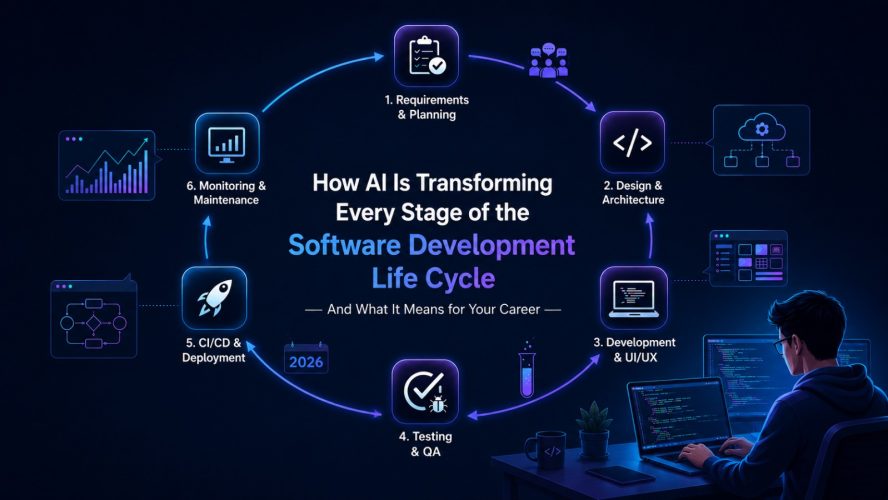
Traditional SDLC diagrams look clean, Requirements, Design, Implementation, Testing, Deployment, Maintenance. Real life is messier. AI fits that mess well because it thrives on iteration: generate, evaluate, regenerate, ship.
AI means less manual work in every phase, faster feedback loops, more automation in decision making and one new skill that matters a lot: knowing what to ask for and how to verify it.
1.Requirements and Planning
This is where projects succeed or die. With AI in SDLC, teams can summarize meeting transcripts into requirements, convert notes into user stories, identify missing requirements, and generate edge cases before coding begins. AI also helps with AI project management, clustering features, surfacing patterns from feedback, and drafting PRDs. This is generative AI for business analysis in action.
For those who are looking for the best software development companies to navigate this evolving landscape, Microweb Global, stands out as a top software development company in Sri Lanka, headquartered in Colombo and serving businesses across Australia, the UK, UAE and beyond. As a leading custom software development agency they build custom software, ERP systems, mobile apps, AI-powered tools and high-converting websites, delivered on time and to enterprise standards.Whether you need offshore software development, bespoke software development, or enterprise software development, Microweb Global delivers results.
2.System Design and Architecture
AI in system design acts like a second brain, proposing architecture options, evaluating tradeoffs, suggesting cloud components, and supporting threat modeling as part of secure software development. But it still needs human judgment. Use AI to generate options fast, then validate with experience.
Top custom software development companies are already embedding AI into their architecture review processes to move faster and reduce risk.
3.UI/UX and Prototyping
AI in UI/UX speeds up prototyping dramatically from one mockup per week to five per day. It generates wireframes from text prompts, checks accessibility, and ensures design consistency. For frontend developers, value shifts toward reusable components, performance, and design systems.
4.Coding and Implementation
This is what everyone talks about, and for good reason. AI programming assistants like GitHub Copilot, Claude, and Cursor handle boilerplate, SQL, API clients, refactoring, and test generation. The best AI coding tools raise productivity for good developers and expose weak fundamentals faster. The new bottleneck isn’t typing, it’s reading, verifying, and maintaining generated code.
Top AI software development tools are raising productivity for good developers and exposing weak fundamentals faster. The new bottleneck isn’t typing, it’s reading, verifying, and maintaining generated code.
Software development outsourcing companies and offshore software development teams are increasingly using AI coding tools to deliver faster without sacrificing quality.
Whether you work at a software development agency, a SaaS development agency, or an offshore software development company, AI coding assistants are now standard tools, not optional extras.
5.Code Review
AI code review catches bugs, readability issues, insecure patterns, and style inconsistencies instantly. The best workflow: AI reviews first, developer fixes obvious issues, human review focuses on architecture and product impact.
6.Testing and QA
Testing is where good intentions die. AI testing tools change that by generating unit tests, integration tests, edge cases, and test plans automatically. AI for software testing shifts QA toward strategy, automation engineering, and risk-based testing rather than manual clicking.
7.CI/CD and Deployment
AI in DevOps helps generate pipeline configs, detect flaky builds, suggest safer deployment strategies, and draft release notes. In mature setups, AIOps enables automated rollback decisions and anomaly detection. DevOps with AI is moving toward self-healing systems.
8.Monitoring and Incident Response
AIOps is not a buzzword anymore. AI monitoring summarizes logs, correlates errors with releases, drafts incident timelines, and generates postmortems. AI for observability reduces chaos, humans still make the decisions that matter.
9.Documentation
AI documentation tools generate doc drafts from code, summarize APIs, and create onboarding guides. The catch: AI makes it easy to create lots of docs, so teams need a process to keep them accurate. Automated documentation is only valuable if it stays true.
What This Means for Your Career
Skills that become more valuable: problem decomposition, system design fundamentals, code review judgment, security awareness, product thinking, and prompting plus verification.
AI will reduce demand for repetitive CRUD work and low-quality boilerplate. It increases demand for people who can ship real outcomes, cleanly, safely, with judgment.
A Simple AI-First SDLC Workflow
Planning → draft user stories with AI, then edit. Design → ask AI for architecture options, pick one, document why. Coding → use AI for scaffolding and refactors, you own the final code. Testing → generate unit tests, add tricky edge cases yourself. PR review → run AI checklist before human review. Deploy → use AI to summarize release risk and draft notes. Ops → use AI to summarize logs and draft postmortems.
Conclusion
AI is not replacing the SDLC. It’s wrapping around it. You still need requirements, design, code, tests, and deployment. What changes is speed and the expectation to iterate faster.
Learn the tools. Double down on fundamentals. Become the person who can validate, integrate, and lead. That’s the job now.
FAQs
How is AI transforming the SDLC? By reducing manual work, accelerating feedback loops, automating decisions, and introducing new skills like knowing what to ask AI and how to verify outputs.
What role does AI play in requirements gathering? AI converts stakeholder input into user stories, summarizes meetings, identifies gaps, and predicts effort, improving AI in product management significantly.
Can AI assist in system design? Yes, proposing architecture options, evaluating tradeoffs, capacity planning, and threat modeling. Human validation is still essential.
How does AI improve UI/UX prototyping? Faster mockups, accessibility checks, design consistency, and more frequent iterations between engineers and designers.
What skills should developers focus on? Problem decomposition, system design, code review, security awareness, product thinking, and AI prompting with verification.
Are there specialized AI tools for different SDLC phases? Yes, AI coding tools, AI project management platforms, DevOps automation, and AI QA tools each target specific phases for better efficiency and quality.