

Last updated 18 October 2026
More Australian businesses now outsource software development to Sri Lanka, and most start by comparing hourly rates. The rate matters, but it rarely decides whether a project succeeds. What decides it is how much of your working day overlaps with the team, who owns the code, how personal data is handled under Australian law, and whether the partner can work like an extension of your own team.
This guide covers all of it: 2026 rates converted to AUD, a worked cost example, time-zone overlap for every Australian capital, the Privacy Act obligations that apply when work goes offshore, contract terms to insist on, and a checklist for vetting a Sri Lankan software company. We’re a Colombo-based software company that works with Australian clients, so we’ve also been clear about when offshore development is the wrong choice.
In this guide
- Why Australian businesses are building offshore teams in 2026
- What it costs: Australian vs Sri Lankan rates
- Time zones: how much of your day overlaps
- What to outsource, and what to keep in Australia
- Privacy, data and contracts
- Why Sri Lanka, compared with other options
- 10-point vetting checklist
- When outsourcing is the wrong choice
- How Microweb Global works with Australian businesses
- Frequently asked questions
Why Australian businesses are building offshore teams in 2026
The main driver isn’t cost. It’s capacity. Australia is expected to need around 1.3 million technology workers by 2030, leaving a shortfall of roughly 300,000 people. Local senior software engineers command around AU$130,000 to AU$185,000 in salary, and once superannuation, office space and other overheads are added, a five-person development team can cost between AU$656,000 and AU$809,000 a year.
A 2026 survey of 214 organisations, almost all headquartered in Australia, found businesses are losing work and delaying contracts because they can’t hire the skills they need in time. Most were using offshore teams to supplement their local staff rather than replace them. The same research found 79% of employers said their offshore teams were adopting AI at the same pace as, or faster than, their onshore staff, and “AI enablement” was the top quality employers now look for in an offshore partner.
Sri Lanka has become a serious option in this market. Its IT and business process management (IT-BPM) exports reached US$885 million in the first half of 2026, up almost 18% on the same period in 2025, making it the country’s fastest-growing export category.
What it costs: Australian vs Sri Lankan development rates in 2026
Rates vary by seniority, technology and engagement model, so treat these as market ranges, not quotes.
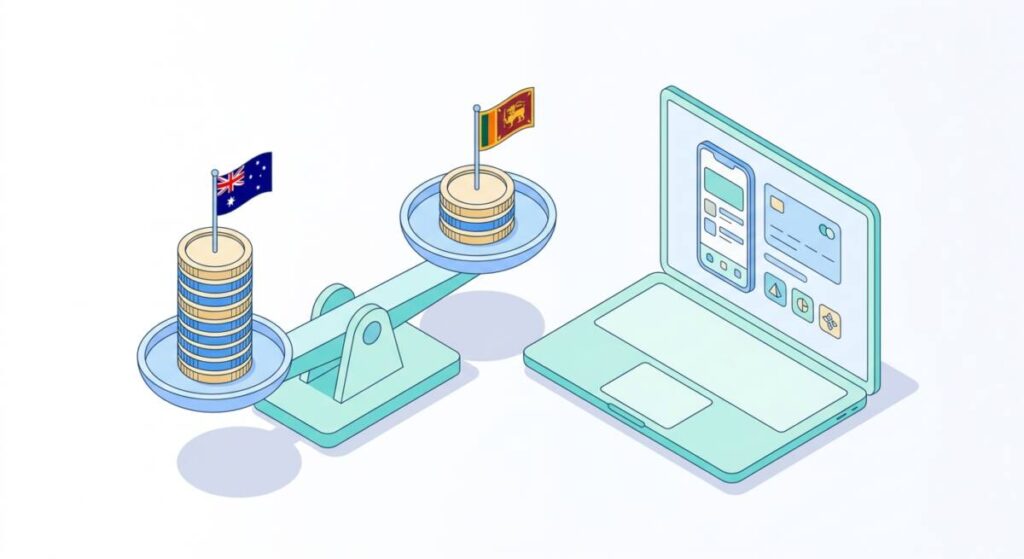
| Where the team is | Typical hourly rate | Approx. in AUD |
|---|---|---|
| Australian app or software developer / agency | AUD 100–200 | AUD 100–200 |
| Sri Lankan software development company | USD 25–40 | AUD 36–58 |
Worked example: a 1,500-hour project
Take a mid-sized build such as a customer portal with a mobile app, an admin dashboard and two integrations, estimated at 1,500 hours of design, development and testing.
| Team | Rate range (AUD/hour) | 1,500 hours at that rate |
|---|---|---|
| Australian team | 100–200 | AUD 150,000–300,000 |
| Sri Lankan team | 36–58 | AUD 54,000–87,000 |
Even comparing the top of the Sri Lankan range with the bottom of the Australian range, the offshore rate is a little over half (AUD 58 vs AUD 100 an hour).
Costs the hourly rate doesn’t show
- Your own time. Someone on your side has to own the product, answer questions and accept work. Budget a few hours a week at minimum.
- Discovery. A paid discovery or scoping phase before the build saves money, because unclear requirements are the biggest cause of overruns.
- Currency movement. If you’re invoiced in USD, the AUD cost moves with the exchange rate. In 2026 the Australian dollar has traded between roughly US 67 and 73 cents. Ask whether the vendor can quote in AUD.
- Maintenance. Plan on around 15–20% of the build cost each year for updates, security fixes and hosting, whoever builds it.
- Handover. If you ever move the work back in-house or to another vendor, documentation and knowledge transfer take time. Agree this up front.
The cheapest rate is rarely the cheapest project. A team that asks hard questions early and delivers working software every two weeks will cost less overall than a cheaper one that needs rework.
Time zones: how much of your working day overlaps with Sri Lanka
Sri Lanka runs on UTC+5:30 all year and doesn’t use daylight saving, so the gap with most Australian cities changes in October and April.
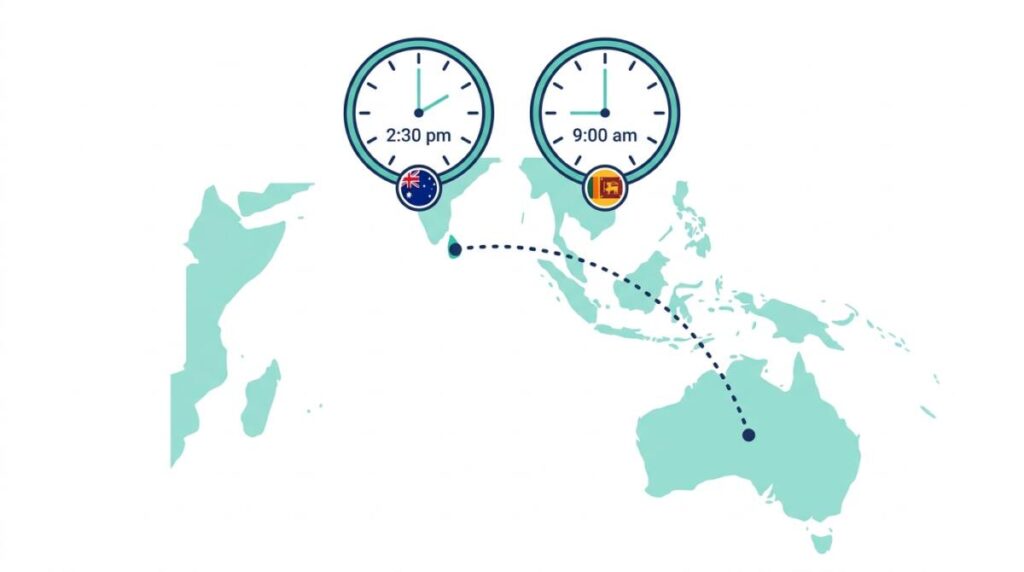
| Australian city | Hours ahead of Colombo (Oct–Apr / Apr–Oct) | 9:00 am in Colombo is… |
|---|---|---|
| Sydney, Melbourne, Canberra, Hobart | 5.5 / 4.5 | 2:30 pm / 1:30 pm |
| Brisbane | 4.5 all year | 1:30 pm |
| Adelaide | 5 / 4 | 2:00 pm / 1:00 pm |
| Darwin | 4 all year | 1:00 pm |
| Perth | 2.5 all year | 11:30 am |
For east-coast businesses, the Sri Lankan morning overlaps with your afternoon, giving three to four shared hours on a standard day. Many Sri Lankan teams working with Australian clients start earlier to stretch that to four or five hours. Perth gets almost a full shared day.
The gap also works in your favour. Feedback you send at 4 pm can be acted on while you’re offline, so you start the next morning with a new build to review. Teams that hold a short daily call during the overlap and keep everything else in writing tend to get the most from this rhythm.
What to outsource to Sri Lanka, and what to keep in Australia
Work that suits an offshore team: web and mobile app builds with a clear scope, MVPs, customer and staff portals, integrations between existing systems (CRM, ERP, accounting, payment gateways), AI features such as chatbots and document automation, QA and testing, and ongoing maintenance of existing products.
Work to keep close: product ownership and prioritisation, key customer relationships, regulatory sign-off, and anything that needs people physically on site.
| Engagement model | How it works | Best for |
|---|---|---|
| Fixed-price project | Agreed scope, price and milestones after discovery | Defined builds: a website, app or portal with clear requirements |
| Dedicated team | A team works only on your product on a monthly basis | Ongoing product development with a changing roadmap |
| Staff augmentation | Individual developers join your existing team | Filling a specific skill gap in a team you already manage |
| Hybrid | Australian product owner or tech lead, Sri Lankan delivery team | Larger or regulated projects that need local accountability |
Privacy, data and contracts: what Australian law expects
Outsourcing the build doesn’t outsource your legal responsibilities. These are the points to plan for. This is general information, not legal advice; have an Australian lawyer review your contract.
Sending personal information overseas (APP 8)
If your developers can see customer data, Australian Privacy Principle 8 on cross-border disclosure applies. In general, you must take reasonable steps to make sure the overseas recipient handles the information in line with the APPs, and you can remain accountable for what they do with it. Law firms note that businesses often assume overseas cloud storage doesn’t count as disclosure, when APP 8 can still apply.
The simplest protection is to keep real customer data away from the development team. Use anonymised or synthetic test data, host production systems in an Australian cloud region, and give offshore developers access only to what they need.
Automated decision-making rules from 10 December 2026
From 10 December 2026, organisations covered by the Privacy Act that use computer programs to make or substantially support decisions that could significantly affect someone’s rights or interests must explain this in their privacy policy. That includes AI and rule-based tools, such as automated approvals, scoring or eligibility checks. If the software you’re commissioning does any of this, write it into the requirements now so the system can tell you what it decides and on what data.
Your vendor’s obligations in Sri Lanka
The core duties of Sri Lanka’s Personal Data Protection Act apply from 1 January 2027, so your Sri Lankan partner will have its own data protection obligations as well. Ask how they’re preparing. (We’ve covered the PDPA requirements in detail here.)
Contract terms to insist on
- IP ownership: all code, designs and documentation assigned to your business on payment.
- Code in your repository: work committed to a GitHub, GitLab or Bitbucket account you own, from day one.
- Your accounts: domains, cloud hosting, app store listings and third-party services registered to your business.
- Confidentiality and data handling: who can access what, how data is stored and deleted, and breach notification timeframes.
- Warranty: a defined period after launch in which defects are fixed at no cost.
- Exit and handover: documentation and transition support if you end the engagement.
- Governing law and currency: which jurisdiction applies, and whether you’re invoiced in AUD or USD.
Check with your accountant how GST applies to imported services for your business, and if you plan to claim the R&D Tax Incentive, get advice before signing, because the rules for overseas activities are strict.
Why Sri Lanka, compared with other offshore options
- English as the business language, which makes written specs, documentation and daily calls straightforward.
- A similar time-zone position to India, with good overlap for Australian afternoons.
- Depth in finance, insurance and telecommunications, sectors Sri Lanka’s software industry has long focused on.
- A smaller, more relationship-driven market. There are fewer firms than in India, so you’re more likely to work directly with senior people, but you have a smaller pool to choose from, which makes vetting more important.
How to vet a Sri Lankan software development company: 10-point checklist
- Ask to see live projects similar to yours, and test them on your phone.
- Speak to at least one current client, ideally one outside Sri Lanka.
- Meet the people who will actually work on your project, not only the sales team.
- Ask how they run a sprint: planning, demos, and how often you’ll see working software.
- Confirm the code will live in a repository you own from the first commit.
- Ask how they handle personal data, test environments and access control.
- Check which hours they’ll be available during your working day.
- Ask how they use AI tools in development, and how they review AI-written code.
- Get a written scope with exclusions, so you know what isn’t included.
- Start with a paid discovery or a small first milestone before committing to the full build.
When outsourcing is the wrong choice
Offshore development isn’t right for every project. It’s harder to make work when nobody on your side has time to own the product, when you need people on site every day, or when a contract or regulator requires all work to be done in Australia. If any of these apply, a local team, or a hybrid model with an Australian lead, is usually the safer choice.
How Microweb Global works with Australian businesses
Microweb Global is a software development company headquartered in Colombo, Sri Lanka. Since 2020 we’ve built custom software, ERP systems, mobile apps, AI tools and websites for businesses in Australia, Sri Lanka, the UK and the UAE.
- Discovery first. We start with a scoping call, then give you a fixed-price quote with a clear scope and milestones.
- Your code, your accounts. Work goes into your repository and your cloud accounts from day one.
- Australian-hours communication. Daily availability during your afternoon, with demos every sprint.
- Full-stack delivery. Custom software, mobile apps, websites and AI development under one roof.
Outsourcing software development to Sri Lanka: frequently asked questions
Is it cheaper to outsource software development to Sri Lanka than to build in Australia?
Usually, yes. Sri Lankan software companies typically charge around USD 25–40 an hour (about AUD 36–58), compared with AUD 100–200 for Australian developers. Once you add your own management time, discovery and maintenance, the total saving is smaller than the rate difference, but it is still significant for most projects.
How many working hours overlap between Australia and Sri Lanka?
East-coast cities are 4.5 to 5.5 hours ahead of Colombo depending on daylight saving, which gives three to four shared hours on a standard day, often more when the Sri Lankan team starts early. Perth is only 2.5 hours ahead, so almost the whole day overlaps.
Does the Australian Privacy Act apply if my developers are in Sri Lanka?
Yes. If developers can access personal information, Australian Privacy Principle 8 on cross-border disclosure applies, and you can remain accountable for how they handle it. The safest approach is to give offshore teams anonymised test data and host production systems in an Australian cloud region.
Who owns the code when I outsource development?
You should. Your contract should assign all intellectual property to your business on payment, and the code should be stored in a repository your business owns from the first commit.
What kinds of projects suit an offshore development team?
Projects with a clear scope work best: web and mobile apps, MVPs, customer portals, system integrations, AI features, testing and ongoing maintenance. Keep product ownership and key customer relationships in Australia.
How do I pay a Sri Lankan software company?
Most invoice by milestone for fixed-price projects or monthly for dedicated teams, by international bank transfer. Ask whether they can invoice in AUD to avoid exchange-rate risk, and check GST treatment with your accountant.
Get a fixed-price quote for your project
Tell us what you want to build. After a short discovery call, we’ll give you a fixed-price quote in AUD with a clear scope, timeline and team, so you know the full cost before work starts.
Sources
- Australia’s tech talent shortage and local team costs, GearBrain
- Australian firms lose customers to skilled role gaps, IT Brief Australia
- ICT and finance lift Sri Lanka’s services exports, Outsource Accelerator
- Mobile app development cost in Australia, 2026, SolGuruz
- Sri Lanka outsourcing statistics and rates, 2026, Stealth Agents
- AUD/USD exchange rate history, 2026, Exchange-Rates.org
- Australian privacy compliance: four key developments in 2026, Corrs Chambers Westgarth
- OAIC and the automated decision-making obligation, MinterEllison
- Gazette Extraordinary No. 2498/16 (PDPA commencement), Data Protection Authority of Sri Lanka